Welcome to the Internal Medicine Lecture Series!
Do you want to learn medicine from university faculty? Are you a resident or medical student looking to learn practical, evidence based approaches to your patients? Are you a physician so excited about MOC that you want to get started studying right now?
Our vision is to teach the world medicine. We believe in the concept of Free Open Access Medical Education (#FOAMed) and we focus on internal medicine (#FOAMIM). Our content will always be free to all who want to learn and take better care of patients.

Little Lectures
Based on feedback from YOU, our loyal viewers, we are excited to present an under ten-minute video series created by residents for learners. These will focus on delivering just-in-time algorithms, practical clinical knowledge and board tips on high-yield topics. These lectures will be provided by the University of Louisville Internal Medicine residents.
Our Most Recent Lectures
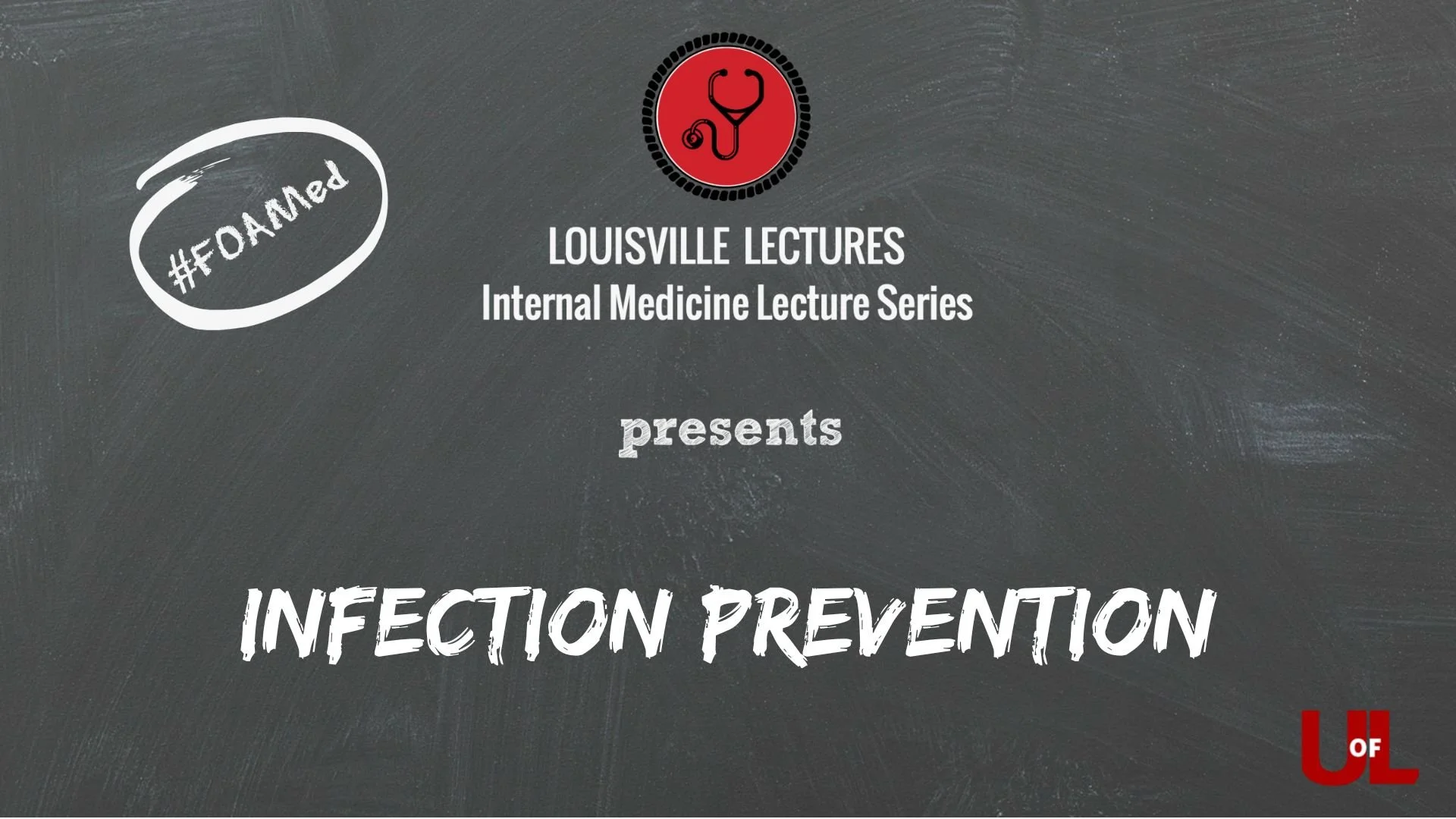
Crystal Heishman presents an introduction on the broad topic of Infection Prevention. Heishman presents how to identify methods to prevent infectious disease transmission and how to implement device related infection prevention strategies for CAUTI and CLABSI. After, she discusses appropriate testing requirements for C.Diff.
Dr. Bryan Moffett presents "Sodium Derangements in the Medical Patient" by first differentiating the difference between total body sodium and sodium concentration. The then breaks down the physiology, causes, and treatment of hyponatremia.
Dr. Ben Rogers presents a lecture on reflux by discussing a classic presentation of reflux as well as testing. Dr. Rogers emphasizes modifying care and diagnosis towards each patient with their own unique symptoms.
In this presentation, Dr. Ryan Doster gives an introduction to diagnostic stewardship after last week's discussion on antimicrobial stewardship. After, Audry Hawkins, PharmD, BCIDP, returns to give an overview on blood culture. Click here for a lecture on Antimicrobial Stewardship.
In this introduction to antimicrobial stewardship, Audry Hawkins first lists untoward effects of antibiotic use. She then describes antibiotic stewardship principles, goals, and strategies. After, she recognizes changes in the regulatory roadmap and national landscape of antimicrobial stewardship over the past few years, including requirements for accreditation for stewardship programs. Lastly, she identifies proven benefits of antimicrobial steward ship; and finally, Sarah Moore reviews the available local and state-level resources.

Dr. Malika Rawal presents Adrenal Insufficiency by first answering the question: What Is Adrenal Insufficiency? She then reviews its causes as well as some basics of cortisol. After, Dr. Rawal discusses testing and treatment.
Everything you need to know about Louisville Lectures starting with our Boot Camp; where the Louisville Lectures team highlights some of our most-viewed lectures. Our Boot Camp covered a series of high-yield, critical topics that are useful to starting interns. For more recent lectures, visit our IMLS Home Page.
Dr. David Armstrong presents Systemic Lupus Erythematosus by first presenting a case. He then discusses the history of SLE as well as the different kinds of lupus. After, he differentiates between systemic lupus erythematosus and drug-induced lupus. And finally, Dr. Armstrong gives examples of treatment and drug induced lupus management.

In Glomerular Disease Part One, Dr. Dawn Caster begins by discussing the classifications of common renal pathology and after, focuses on nephrotic syndrome. Dr. Caster gives an overview of nephrotic syndrome and its associated abnormalities as well as the mechanisms of the thrombophilic state in nephrotic syndrome. In part two. Dr. Caster will discuss Glomerulophritis.
Alexa Filley, PharmD, delivers a lecture on Common HIV Regimens and Opportunistic Infection Prophylaxis. She first reviews common human immunodeficiency virus treatment regimens and after, discusses patient/medication characteristics to guide therapy selection. Filley concludes her presentation by reviewing and applying Department of Health and Human Services (DHHS) Guidelines on opportunistic infection prophylaxis in patients with HIV.
Dr. Malika Rawal gives an overview on Gender-Affirming Hormone Therapy. Dr. Rawal first discusses the different types of transition as well as general definitions and after, lists terms physicians should and should NOT use when treating patients. Dr. Rawal presents what a visit would look like and how to work with the patient, expectations of hormone therapy, and the physical effects of hormone therapy for feminizing hormone therapy along with masculinizing hormone therapy.
Dr. David Armstrong presents Seronegative Spondyloarthropathies and emphasizes these take home points:
- HLA-B27 does not diagnose SNSAs
- Inflammatory back pain improves with exercise
- Red eye with decreased visual acuity needs slit lamp
- Nail pitting correlates with psoriatic arthritis
- NSAIDs help everything except enteropathic arthritis
Dr. Chris Reed presents an overview of congenital arrhythmogenic pathologies by first focusing on two families of diseases: structural and conduction. He then discusses pathophysiology and cause of disease and after, the diagnostic workup and what to include in a consultation. Finally, Dr. Reed presents management plans and when to pursue intervention.

Our new Chair of the Department of Medicine, Dr. Kim Williams, presents his first Grand Rounds on the topic of Nutrition, Health Equity, and CV Mortality. First, Dr. Williams discusses some of the main issue in the United States including being its expensive and broken healthcare system. With the expectance of an increase in cardiovascular disease and stroke mortality in the US in the upcoming decades, particularly in minority groups, Dr. Williams believes our poor nutrition promotes and accentuates health inequities and ethnic disparities. Dr. Williams encourages the implementation of education around plant-based diets which are associated with lower rates of of systemic hypertension, hyperlipidemia, obesity, and diabetes.
Dr. Laura Bishop presents "Opiate Use Disorder in the Inpatient Setting: To Bup or Not to Bup with Dr. Bishop" by first examining the practice for adjustments to create space of destigmatizing patients with SUDS. She then discusses the symptoms of opiate withdrawal as well as the pharmacology of buprenorphine and its efficacy/safety in treating opiate use disorder. Dr. Bishop then identifies patients who would benefit from buprenorphine and constructs a plan of care for patients with opiate withdrawal, including non-MAT and MAT options.
Dr. Rebecca Redman presents "Cancer Doesn't Discriminate... or Does It?" by first reviewing racial and ethnic differences in cancer incidence and outcomes. She then explores initiatives to address cancer disparities. After, she examines the role of clinical trials in challenging status quo.

Dr. Forest Arnold returns to discuss co-infections in COVID-19 by first presenting case reports and pathophysiology. After, he explains etiology and frequency and finally, diagnosis and treatment.
Dr. Regan Wade presents "Heart Failure Pharmacology" by first reviewing heart failure pathophysiology as it relates to pharmacotherapy. She then discusses guideline directed therapy and other agents indicated to optimize heart failure care. After, Dr. Wade evaluates literature related to new therapies and indications for medications in patients with heart failure.

Dr. Sara Ellingwood presents a talk on Asthma starting with its definition and phenotypes. She discusses making a diagnosis, differential diagnosis, and management. After, Dr. Ellingwood ends with a discussion on when to refer.
Welcome Residents!
The July Effect: residents around the world are beginning their residencies this month, giving many to believe there will be more mistakes made in the hospital. Not to worry! Louisville Lectures has a variety of presentations given by physicians, psychiatrists, and fellow residents here to help you transition seamlessly as well as restore your confidence. You got this!
Check out our Boot Camp where the Louisville Lectures team highlights some of our most-viewed lectures. Our Boot Camp covered a series of high-yield, critical topics that are useful to starting interns. For more recent lectures, visit our IMLS Home Page.
Louisville Lectures
Dr. Forest Arnold returns to present "COVID-19 Vaccines: Wows and Woes" today on Louisville Lectures. In this presentation, Dr. Arnold gives an overview of COVID-19 and vaccines. He then discusses a case of potential thrombosis due to the Johnson & Johnson vaccine as well as the pathophysiology of vaccine-induced immune thrombotic thrombocytopenia (VITT). After, he presents the CDC Advisory Committee on Immunization Practices and the efficacy of vaccines in light of variants. And finally, Dr. Arnold discusses post acute COVID-19 Syndrome (PACS).
Dr. Mark Burns gives an update on COVID-19 by first discussing its history and epidemiology. He then describes the lifecycle of Sars-CoV-2 and the events surrounding the Cytokine Storm. After, he explains the clinical presentation and current commendations for pharmacologic management and finally, the vaccines in phase 3 trials.
Our Chief Medical Resident for Education, Dr. Samuel Reynolds returns to give an introduction on abstract writing. He begins by describing an abstract and its importance and after, he discusses the general process of abstract writing.
Dr. Bree Trischan presents a Little Lecture on Advance Care Planning. In this lecture, she defines advance care planning and advance directives. She then discusses how to talk to patients about advance care planning.
Dr. Nina Vasavada gives an Acid Base Core Lecture by first reviewing dietary sources of acids and alkali. She then reviews renal and non renal mechanisms of maintaining acid/base equilibrium. After, she discusses practice questions.

Louisville Lectures wishes everyone a safe holiday season! Stay #healthyathome and follow CDC guidelines for how to protect you and your loved ones.
Our Chief Medical Resident for Education, Dr. Samuel Reynolds, presents “Basic Science: Molecular Biology in Cardiovascular Disease”. He discusses the basis of Cardiovascular Disease from a molecular standpoint and emphasizes how arrhythmia and cardiac conduction impairment relates to coronary artery disease and how the development of structural heart disease can mean problems for our heart’s ability to conduct electrical signals. Please note: this presentation took place in our Didactics Zoom, so the audio may be harder to hear.
“I remember this feeling of absolute dread when I read that fellowship interviews this year were going to be virtual. Wasn’t the stress of dealing with the COVID-19 pandemic enough, without having to adjust to a whole new system of interviewing for one of the most important positions in my career?”
Dr. Jennifer Olges presents "Health Disparities: Food Insecurity and Food Deserts" by first defining food insecurity and food deserts. She then compares and contrasts hunger and food insecurity and describes the scope of the issue in Louisville/Jefferson County as well as in the clinic population. After, Dr. Olges describes the clinical implications of food insecurity and finally, reviews the process for accessing the food bank in the AIM clinic.

Audry Hawkins is back to discuss antimicrobial stewardship in pneumonia. She starts with comparing differences in guidelines and recent primary literature on empiric treatment of pneumonia. Hawkins then evaluates appropriate empiric step-down therapy and durations and after, discusses the nuances in guideline recommendations for pneumonia.